Protocol Clinical Data Pricing Stock R1

CUVA Peptide Series · Recovery Ampoule

R1

GHK-Cu 2–5% + PDRN ≥1%. Formulated for the peak absorption window immediately after microneedling. Sterile, single-dose, 5ml glass ampoule.
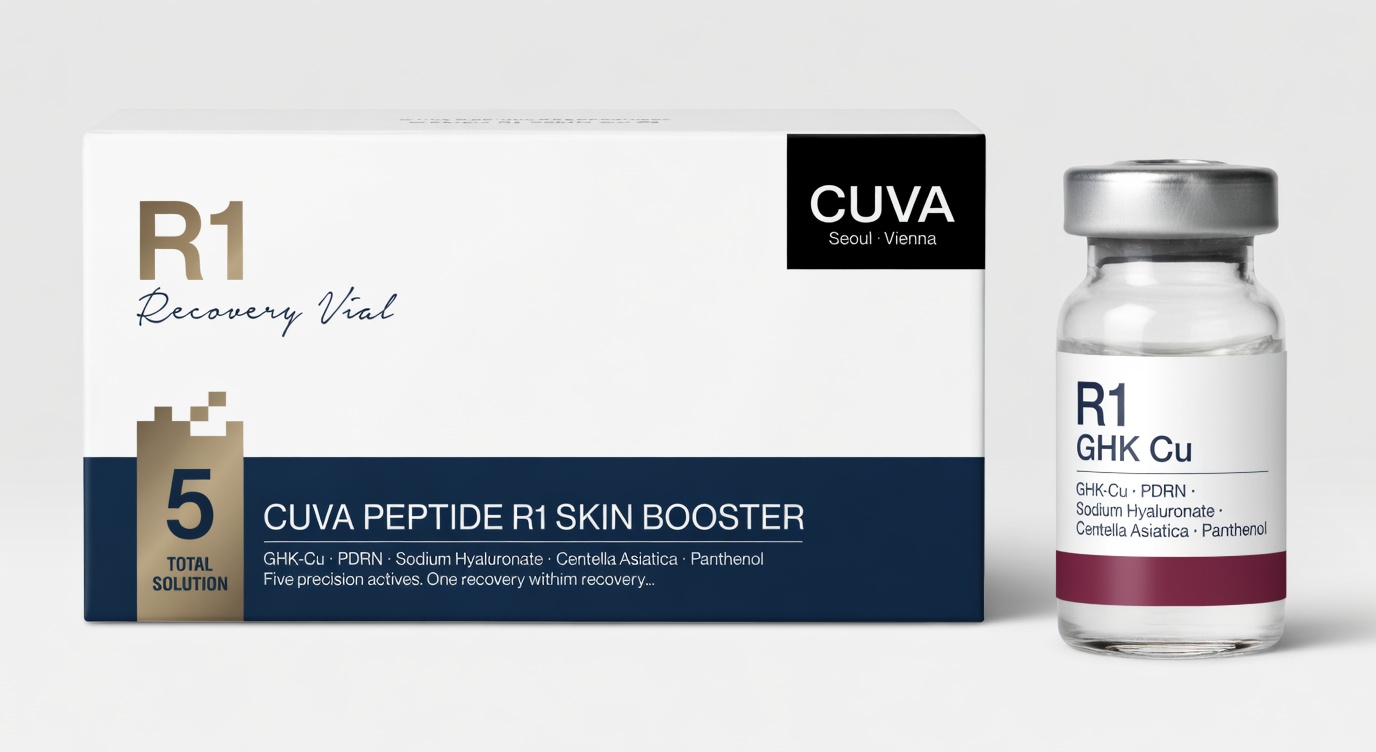
CUVA R1 Recovery Vial — box and vial
Format
5ml sterile glass ampoule
pH
4.5–6.0
Key actives
GHK-Cu · PDRN · multi-MW HA
Compliance
EU 1223/2009
Shelf life
24 months from production

Transparent by design.

Every ingredient in R1 has a specific mechanism. There are no filler actives, no low-dose label plays. Concentrations are calibrated for post-microneedling delivery — where 20–55× normal absorption makes high concentrations not just useful but necessary.

No fragrance. No acids. No retinoids. No parabens. No formaldehyde donors. Open channels mean anything you apply goes in — R1 contains only what you want going in.

pH 4.5–6.0
Format 5ml single-use sterile glass ampoule
Compliance EU 1223/2009
Ingredient Conc. Role
GHK-Cu
Copper Tripeptide-1
2–5% Repair, collagen signalling, gene reset, antioxidant
PDRN
Polydeoxyribonucleotide
≥1% Anti-inflammatory + pro-synthesis via A2A receptor
Hyaluronic Acid
20–100 kDa
1–2% Microchannel delivery vehicle + dermal hydration
Hyaluronic Acid
>1 MDa
0.5–1% Surface calming + film formation
Centella Asiatica 0.5–2% Asiaticoside anti-inflammatory, soothing
Panthenol (B5) 1–2% Wound healing, barrier repair
Allantoin 0.2–0.5% Soothing, stimulates cell proliferation
Phenoxyethanol ≤1% Preservative — no formaldehyde donors
Aqua q.s. Sterile water base

Step-by-step application.

Compatible with dermapen, dermaroller, and RF microneedling devices.

01 — Pre-treatment

Cleanse & prep

Cleanse skin thoroughly. Apply topical anaesthetic if required. Confirm no active infection, open wounds, or known allergy to listed ingredients. Do not apply acid toner or alcohol pre-treatment.

02 — Procedure

Standard microneedling

Perform microneedling at recommended depth: 0.3–1.5mm face, 1.5–2.5mm body. R1 is compatible with dermarollers, dermapens, and RF microneedling devices. No protocol changes needed.

03 — Apply R1

Open and apply immediately

Break the sterile ampoule immediately post-treatment. Apply full 5ml to the treated area within 5 minutes. Press gently with clean fingertips — do not rub. Do not rinse for minimum 4 hours.

04 — Post-care

Protect the window

SPF 50+ the following morning. No retinoids, AHAs, BHAs, or Vitamin C for 48 hours. Gentle cleanser only for 24 hours. Optional: apply a hydrogel or sheet mask immediately after R1 to extend occlusion.

05 — Frequency

Session cadence

Recommended: 3 sessions, 4 weeks apart. Maintenance: every 8–12 weeks. One ampoule per patient per session. Do not re-use open ampoules.

06 — Contraindications

Do not use if

Active skin infection or open wounds. Known allergy to any listed ingredient. Pregnancy or breastfeeding (precautionary). Active isotretinoin use (within 6 months). Keloid-prone skin (assess individually).

EU-compliant claims for patient communication

✓ "Supports skin recovery after microneedling"  ·  "Helps soothe and hydrate skin following microneedling procedures"

✓ "With GHK-Cu and PDRN — two of the most-researched cosmetic peptides"  ·  "Formulated for use immediately after microneedling"

Do not claim: "stimulates collagen", "anti-inflammatory", "repairs skin", "delivers into dermis" — these are medicinal claims under EU Regulation EC 1223/2009.

What each active does.

Mechanism, evidence, and why each ingredient is in R1 at this concentration. All clinical data cited to published peer-reviewed studies.

GHK-Cu
Copper Tripeptide-1
2–5% in R1
Four verified mechanisms
TGF-β receptor signalling for collagen and elastin upregulation. Copper delivery to lysyl oxidase for collagen cross-linking. Antioxidant gene upregulation (SOD1, catalase). Gene expression reset — GHK-Cu modulates 4,000+ human genes toward a younger fibroblast phenotype.
Key data: 134 nmol/mg in skin tissue 9h post-microneedling vs. ~0 on intact skin (Kang Lab, PMID 25690343). Bioactive at 10⁻¹² M (Maquart et al., PMID 3169264). 4,000+ genes modulated (Pickart & Margolina, PMID 29986520).
PDRN
Polydeoxyribonucleotide (salmon-derived)
≥1% in R1
A2A purinergic receptor activation
Activates cAMP → PKA pathway via adenosine A2A receptor — triggering simultaneous anti-inflammatory response (NF-κB suppression, TNF-α/IL-1β/IL-6 down) and pro-synthesis response (TGF-β1, VEGF upregulation). Dual action in the same tissue environment is unique among cosmetic actives.
Key data: PDRN outperformed PRP in microneedling RCT for wrinkle reduction (Vera et al., 2025, p=0.021). ERK phosphorylation + collagen accumulation in dermal fibroblasts (Shin et al., PMID 37350391).
Multi-MW HA
Sodium Hyaluronate (20–100 kDa + >1 MDa)
1.5–3% total in R1
Two-layer delivery system
Short-chain HA (20–100 kDa) penetrates open microchannels into the dermis — acting as a delivery vehicle for the active layer, providing deep hydration, and filling the microchannel space. High-MW HA (>1 MDa) stays at the surface — creates a calming, occlusive film that extends the absorption window.
Why both: Using only one MW leaves either the delivery or the surface protection job undone. R1 uses both fractions at separate functional concentrations.
Centella + Panthenol
Centella Asiatica Extract · Panthenol (B5)
0.5–2% / 1–2% in R1
Recovery support layer
Centella Asiatica (asiaticoside) supports skin comfort in the immediate post-procedure window. Panthenol (provitamin B5) converts to pantothenic acid in skin tissue — supports barrier function and comfort. Allantoin (0.2–0.5%) rounds out the recovery layer: soothing and stimulating cell turnover.
EU claim note: These ingredients allow "soothes and hydrates" and "supports skin recovery after microneedling" claims under EU Regulation EC 1223/2009.

Every claim has a source.

Published, peer-reviewed studies on GHK-Cu and PDRN mechanisms and microneedling delivery. CUVA R1 is a cosmetic product. No therapeutic outcomes are implied.

01 — Microneedling delivery
PMID 25690343
Li, Low, Chong et al. — Kang Lab, NUS · Pharmaceutical Research (2015)
Microneedle pretreatment delivered 134 ± 12 nmol GHK-Cu through human skin in 9 hours. Near-zero penetration through intact skin under identical conditions.
PMC3160154
Kalluri, Kolli & Banga · AAPS Journal (2011)
Skin barrier recovers 4–5 hours post-poration; full pore closure at 12–18 hours depending on depth. Occlusive dressing delays closure further.
PMC4590292
Zhang, Qiu & Gao · Acta Pharmaceutica Sinica B (2014)
Microneedle arrays significantly enhanced transdermal flux of hydrophilic peptides (456–1007 Da). 20–55× delivery increase vs. intact skin.
PMC4102460
Mohammed, Yamada, Lin et al. · PLoS One (2014)
2–22-fold signal improvement for cosmeceutical peptide delivery into ex vivo human skin via microneedles vs. passive topical application.
02 — GHK-Cu (Copper Tripeptide-1)
PMID 3169264
Maquart, Pickart, Laurent et al. · FEBS Letters (1988)
GHK-Cu stimulates collagen synthesis in human fibroblast cultures at 10⁻¹² M. Activity independent of cell proliferation. Foundational sub-nanomolar bioactivity data.
PMID 29986520
Pickart & Margolina · Int J Mol Sci (2018)
GHK modulates expression of 4,000+ human genes — upregulating tissue repair and antioxidant pathways while downregulating inflammatory and degenerative gene sets.
PMID 20703511
Hostynek, Dreher & Maibach · Inflammation Research (2010)
136.2 µg/cm² copper permeated dermatomed human skin passively over 48h; 82 µg/cm² retained as dermal depot. Clinically relevant passive penetration confirmed.
PMID 39963574
Mortazavi et al. · BioImpacts (2025)
2025 review confirms GHK anti-wrinkle properties. Skin penetration identified as primary challenge — complexation and microneedle delivery validated as solutions.
03 — PDRN (Polydeoxyribonucleotide)
PMID 28491036
Squadrito, Bitto, Irrera et al. · Frontiers in Pharmacology (2017)
PDRN's primary mechanism: A2A receptor engagement activating tissue repair, anti-ischemic, and anti-inflammatory cascades through the nucleoside salvage pathway.
PMID 37350391
Shin, Baek, Kim et al. · Molecular Medicine Reports (2023)
PDRN increases ERK phosphorylation and collagen accumulation in dermal fibroblasts while suppressing TNF-α, IL-1β, and IL-6 — dual pro-repair and anti-inflammatory action.
DOI 10.57662/am.v11i2.16753
Vera, Praharsini, Darwinata et al. · Aesthetic Medicine (2025)
RCT (n=24): microneedling + PDRN 3% achieved significantly greater Lemperle wrinkle score reduction than microneedling + PRP (p=0.021).

All references cite published peer-reviewed studies on ingredient mechanisms and delivery conditions under specific experimental or clinical parameters. Results are not a guarantee of product outcomes. CUVA R1 is a cosmetic product regulated under EU Regulation EC 1223/2009. No therapeutic or medical claims are made or implied.

Trade supply

Stock R1
in your clinic.

Request a sample pack or wholesale pricing. We respond within one business day.

Request trade samples View pricing